

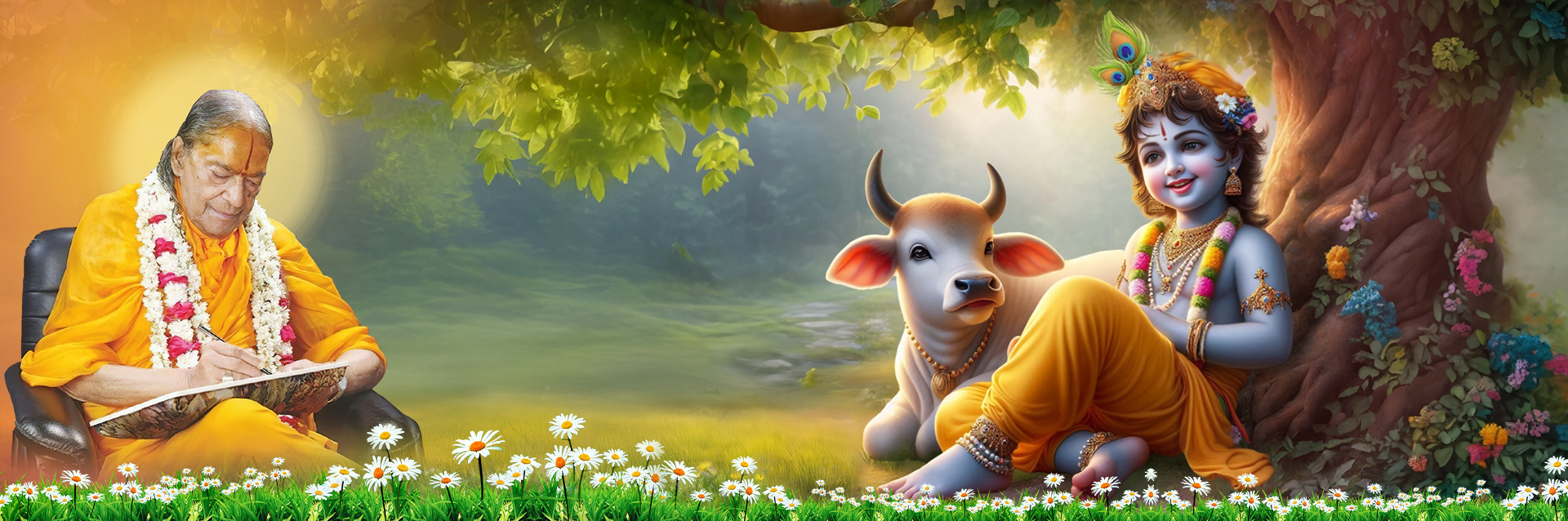

O souls, who like bees, seek the nectar of the lotus feet of the One who is the ocean of sweetness, gentleness, charm and beauty, and is the brother of Balram! As is customary, let us chant the divine name for a while, after which the subject will begin. All glories to the divine couple, Radha Govinda! Now, please pay attention. Who am I? Who is Mine?
While solving these questions, it has been explained to you so far that in the entire world, there are only two kinds of people. One are those whom we can call ignorant, and the others are those whom we can call knowledgeable. In layman’s terms, one is a fool and one is wise. Of these two, 99.9% are fools, and 0.1% are wise. Even this is an overstatement. There aren’t even this many.
How do we define those who are ignorant? Uddhav asked the supreme Lord, Shri Krishna: Scriptural Verse (Bhagavatam 11.19.31) O Lord, who should be called a fool in this world? Shri Krishna replied: Scriptural Verse Bhagavatam 11.19.42 A fool is one who considers himself to be the body. I do not know whether or not any one of you is a fool, but using this definition, you can reflect when you are alone and decide for yourself which of the two categories you belong to. In other words, do you consider yourself to be deh (the body) or dehi (the soul)? There is no third thing. We have only two things: dehi and deh. Dehi means the one having a body. Just as dhani means one who has dhan (wealth), gyani means one who has gyan (knowledge). Similarly, there is one who considers himself to be the deh (the body) and one who considers himself to be the dehi (the soul).
If we need some test to distinguish between these two, then I will tell you that as well. Those who have become complete; those whose life is eternal and whose knowledge is complete – in other words, those whose ignorance is destroyed and whose suffering has ended – that is, those who have attained perfect bliss forever, form the category of those who consider themselves to be souls. And those who are mortal, ignorant and unhappy are those who consider themselves to be the body. That’s it. Now you all can decide which category you belong to. I have given you so many parameters, because if I were to directly tell you who you are, you might start abusing me. “You’re calling us fools! You think of yourself as a great Jagadguru!” We are not ready to be called fools, even though we may actually be fools. Yes! If we are wise and someone calls us a fool, we do not object. We keep smiling. “He’s calling me a fool?” The wise one reflects on this. “He’s calling me a fool. Oh, I understand!” What did you understand? He is a fool. That is why he thinks everyone is a fool. A person who suffers from jaundice sees a yellow hue everywhere.
Understand every definition and every sentence of mine very carefully, and fully grasp it. Where are we going wrong? We find faults with others. What does this imply? We are full of faults. These very faults are coming out. We see only faults everywhere. Otherwise, even if Laila-Majnu were to come before us, we would say, “This is Meera deeply absorbed in the love of Shri Krishna.” We would interpret it like that. However, when we are wrong, then even if the real Meera were to appear before us, we would say that she is just another Laila. Every individual looks around and makes decisions according to his own intellect. When these wrong conclusions stop, then you can assume you are improving.
“Now I do not see anyone’s faults. I am working on seeing my own faults. What are my shortcomings? He called me a fool the day before yesterday, and I am still fuming with anger. My friend, my son, my daughter called me a fool! This is reverberating in my ears, and it’s making me burn up inside! That means I am such a fool that on hearing the word ‘fool’, which is just a combination of letters, I have fallen apart.” So much anger; such negative feelings! This is the sign of a fool.
And when he becomes wise, what will he say? Scriptural Verse (Kabir) With your own money, make a hut in your own courtyard; and invite the one who criticizes you to stay there. And if he is hungry, then feed him too and tell him, “Listen brother, just do one thing – keep abusing me all day long.” And you should not feel upset upon hearing it. This is the condition! Not just in acting to show off to others that you had him stay there, saying to him, “Listen brother, you keep abusing me like this, and I’ll keep smiling so that people think I have become a Saint.”Yes, this also happens in our world. It should be genuine.
So, the one who has understood ‘Who am I? Who is Mine?’ in a practical way is wise, and the one who has not been able to solve this question is foolish. So, in order to solve this, we took the support of perceptual evidence as well as inferential evidence. However, this did not help, because the thing that we are deciding on is vijatiya. What does vijatiya mean? The eyes perform the work of seeing, don’t they? Yes. The ears perform the function of hearing, don’t they? Yes. They are both vijatiya, aren’t they? They perform different functions. Yes. In the same way, this mind and these senses, made of the five elements, are all that we have; and the one we need to decide about is not made of the five elements. He is something else. Who is He? This we do not know. However, He is not of the five material elements. This we know.
So, in order to find out, we took the support of scriptural evidence. We found out ‘Who am I’ from the Vedas and the scriptures. They stated that the name of the ‘I’ is jiva (the individual soul). The word jiva means that which is itself alive (jivit), and also keeps the entity where it resides alive. We then investigated further to discover who the jiva is related to. Is it independent? No, no. We learned that there are three entities. They are beginning-less, infinite, perpetual and eternal. However, of these three, two entities are in the form of powers of the third entity.That is, jiva and maya are the powers, and Brahm (God) is the possessor of the powers.
Maya is insentient, leave it aside. Regarding maya, just understand this much – that it has dominated the jiva since beginningless time. It has established its authority. Note, do not forget. It didn’t establish its authority one day. Maya has always ruled over the jiva since beginningless time. Tell me, how did an insentient entity overpower a sentient entity? Do not say, ‘it did’, say ‘it does’. Why is this so? The strong have authority over the weak, don’t they? Yes. God has the authority. Alright, accepted. However, how is it that maya has authority over the jiva? The soul is sentient and God Himself admits that the jiva is His para shakti (superior power). Scriptural Verse (Bhagavad Gita 7.4) Apara – this maya is nikrishtha (inferior). Scriptural Verse (Bhagavad Gita 7.5) The jiva is para(superior). Bhagavad Gita 7.4, 7.5 So, why is the superior power overpowered by the inferior power? Take note, I did not say, “Why was it?” Why is it so?
Why does maya rule over anyone? Why this question? Because maya is insentient; it cannot do anything at all. Look, this is a towel. It is insentient. I put it there. It is there and will remain there. Yes, it will remain there, decay and decompose. It will stay there because it is insentient. Yes. Maya is insentient, but it is God’s power and is connected to Him. A power cannot exist independently from its possessor, whether it is the jiva, maya or even para; whichever power it may be. God said: Scriptural Verse (Bhagavad Gita 7.14) “Maya is transcendental. It is not merely insentient. And it is extremely powerful.” How powerful? “As powerful as I am.” Oh, now I understand. As powerful as You? Yes!
Look, this is a hand. Hold a hammer with it and hit someone. Everyone who does this uses the same size hammer. However, when one person used it, the iron broke into two pieces; and when someone else used it – pitt, nothing happened. Why? Because the strength of each person who is hitting is different. So, this maya is governed by God. It is insentient but it becomes sentient. What? Look at this towel, it has become sentient. It is moving. It is the hand that moved it. Yes, the hand has moved it, but it’s moving, isn’t it? That hammer hit you? “Yes.” It killed you? “Yes.” So, did you die because of the hammer? “Oh no sir, how could the poor hammer kill me? It was the hand that held the hammer.” How could the poor hand kill you either? That soul within ordered the hand to hit. The soul departed, and the hand is lying there. There are four men lighting the funeral pyre, but the body does not protest, “You scoundrels! You’re burning me!” “My very own son is setting me on fire!”
Scriptural Verse (Ramayan) (It is due to the power of God that maya appears real.) It is not real; it just appears to be. And God said: (Scriptural Verse) “Whoever surrenders to Me is freed from maya.” This bhoot (ghost) that is haunting all the souls, meaning this maya … One meaning of the word bhoot is the soul. Scriptural Verse (Taittiriya Upanishad 3.1) Scriptural Verse (Bhagavad Gita 9.29) So, no one can get rid of this ghost, this sorceress, this witch, maya, which is haunting them, using their own efforts. There have been great rishis, munis and yogis in Sat Yug and other ages. Vishwamitra created a new celestial abode. Oh, Vishwamitra turned a woman into stone! She was a celestial damsel. Yes, yes, all this is possible, but no one can conquer maya. “It is Mine. If someone becomes as powerful as I am, then he can conquer maya.” That’s it. There is only one answer.
Scriptural Verse (Bhagavatam 5.18.4) There have been great gyanis, great yogis in different eras, but they all came under the influence of maya. They were not always dominated, but they became dominated again. They found temporary freedom from maya while in samadhi. Maya does not go there. However, when they came out of their samadhi, maya grabbed them again. For example, if you are attacked by bees, then wherever you run, they won’t leave you. However, if you submerge yourself in water, the bees will keep hovering above the water. The poor bees cannot go into the water. However, they keep watching to see when you raise your head; and as soon as you raise your head, they attack again. Maya is just like this. Maya means desire, anger, greed, infatuation, jealousy, animosity. All these are commanders of maya. All these reside within us.
If someone were to look at all of you now to see if anyone had feelings of desire, anger, greed or envy inside of them; he would be very surprised, “No, sir. Everyone’s mind and intellect is focused on understanding Maharaj Ji’s words. These are invaluable gems of wisdom.” However, if the person sitting next to you were to push you a little … Oh! Here it comes! What? That which was sitting hidden inside you, on the lookout! “Hey, you! You gave me a shove?” Now if he also retaliates, this one becomes even more furious. He says, “You scoundrel!” He replies, “You’re the scoundrel!” Now they even start hitting each other. Jagadguru Ji may keep shouting, “Hey! What are you doing?” – “Oh Guru Ji, this thing inside of me is making me do this. That which was hiding, the servant of maya.”
So, by virtue of being a power of God, maya has overpowered the soul. And until the soul attains its source, God, attains God’s grace, maya will not leave. Make a note of this conclusion. Don’t try anything; you will be needlessly frustrated. “Let me just try something once and see.” What will you do? “I’ll think.” What else will you do? “I’ll just think.” What will you think? “That I have an enemy and now I will never harbor thoughts of enmity. I will practice that from now on. Yes, I will not think about him. I will not think about him.” About whom? “Him.” But you are thinking about him. You are thinking about the very person you are planning not to think about. This is not the cure. The remedy is, “From now on, I will think only about God.” Now the mind has no time to think about the enemy. There is just one cure.
So, it is necessary to attain God. He alone is ‘mine’. Until now, we considered ourselves to be the body; that is why we considered the world to be ours. That is why, to attain our ultimate aim: bliss, knowledge, etc., we kept running around in the world. A person is standing at the crossroads. He says, “Oh brothers! I want to go home, but I have forgotten the way to Prem Nagar (the abode of love).” So, the ones going in the wrong direction, which is 99.9% of people, say, “Hey, don’t you see where everyone is going?” – “There are a few people going that way.” “Ah, they are fools. Don’t be a fool. Let’s go, this is the right way.” It’s only in this direction. Get knowledge from everyone; get happiness from everyone. Have a mother, a father, a son, a daughter, a wife, a husband; and get a house, two houses, four houses. Accumulate ten million, twenty million.
Scriptural Verse (Bhagavatam 9.19.13) Even if the entire world is given to someone, then what? “Oh, I haven’t got that yet.” What is that? “Peace, bliss, knowledge, immortality. I haven’t got that because …” Scriptural Verse Bhagavad Gita 8.16 One has to return even after reaching Brahmalok. Didn’t I tell you that even the lifespan of Lord Brahma is limited? Even he has to leave his position, let alone Indra. And in our world? You see the prime ministers and presidents. In India alone, six or seven prime ministers and presidents are sitting in their homes in retirement. Does anyone visit them now?
So, God is our source; we are a part of Him. Therefore, it is our nature to attain Him alone. It is our nature. Look, here is a lump of soil. Soil means a part of the earth, a lump. This lump of soil is completely attached to the earth.It desires only the earth. You will say that if it desires only the earth, why is it separated from the earth? It is because my hand is holding it. If the hand lets go of the soil, there is no need to throw it down. Just release it. The earth will automatically pull its child, its part, towards it. The flame of every fire rises upwards. It is a part of the sun. Every river flows towards the sea, which is its source. So, every soul loves only God as it is a part of God; it is His power.
“Oh, but there are so many atheists, and you say every soul.” No, no. Scriptural Verse (Valmiki Ramayan) Valmiki challenged that there can be no one in the world who is not a devotee of Lord Ram. Oh, you may not accept Lord Ram. A Muslim may say, “I am a devotee of Khuda, not your Ram.” That’s okay. One of the names of our Ram is Khuda. Don’t get upset. A Christian comes forward and says, “Listen brother, this Khuda and Ram are not mine.” Then who is yours? “God.” Okay, then you can call him God. You may call Him by any name. So, He has one more name: Anand (Bliss), Happiness, Peace. This is what you want, right? – “Well, what else would I want?” So, this bliss, peace, happiness is God Himself. We are constantly trying to attain these and will have to keep doing so. If one tries to think the opposite, even for infinite eons, “I want sorrow, I want sorrow, I want distress”, it is impossible. He can never revolt against happiness.
So, we reflected upon God and learned that He is unattainable. Scriptural Verse (Mandukya Upanishad 7) The Vedas are saying this. He will not be seen with these eyes. His words cannot be heard with these ears. He cannot be contemplated upon by the mind, nor can the intellect make a decision about Him. So, does that mean that no one till today has ever attained God or happiness or peace? No, some have: those on whom He bestows His grace, His power, His bliss, as a gift. We need God’s eyes to see God. It’s a very simple thing. If someone asks you, “Who can see God?” God. Who can hear God’s words? God. Speech, touch, form, taste, smell, thoughts, decisions – all the work related to God can be done by God alone. And even if a donkey has done it, then it was God within who made him do it.
Suppose you are possessed by a spirit. As long as that spirit is within you, it will make you work according to its capability. Similarly, when one is possessed by the ghost of Nand’s Son (Shri Krishna), then everything he does is divine. None of his actions are material. So, in order to attain that grace, karm was outlined, and we learned that it is temporary. It will only take us to the celestial realm, and it is also impossible to perform. Scriptural Verse (Bhagavatam 6.3.19) Even understanding it is impossible. Scriptural Verse Bhagavatam 11.27.6 There is no end to ritualistic practices. And this has been declared by God. No one can understand its subtleties. And what’s more, karm cannot destroy the bondage of karm. Scriptural Verse (Bhagavatam 6.2.17) It is only your sins that will be destroyed. Even your own mind won’t be purified.
So? There is the path of gyan (knowledge). We reflected upon it. For this, a formidable condition appeared right at the beginning. “First become peaceful, then come to Me.” Fulfill the four prerequisites. That is impossible in Kali Yug. And even if was possible in Sat Yug, still it was found that the aspirant falls on the path time and again. Even after reaching the final stage, he falls down. Veda Vyas said this through Brahma: Scriptural Verse Bhagavatam 10.2.32 Shankaracharya also said: Scriptural Verse (Shankaracharya) Manu too said: Scriptural Verse (Manu Smriti) Scriptural Verse (Markandeya Purana 78.42) So, maya is so powerful that no karmi, gyani, yogi or anyone can conquer it.
With reference to yog, God told Uddhav, “Take the support of yog. Then you will be able to restrain the mind. “When he inquired about yog and received an answer from Shri Krishna, then Uddhav, who was such an elevated gyani, says: Scriptural Verse (Bhagavatam 11.29.1) Until the mind is fully under one’s control, the practice of yog is impossible. And even if the yogi progresses uninterrupted, then his final stage will just be asampragyat samadhi. What is asampragyat samadhi? Scriptural Verse Mandala Brahma Upanishad 1.10 He forgets everything. Everything? Yes. He forgets these three – the meditator, the object of meditation and the meditation. Scriptural Verse (Bhagavatam 12.12.52) This is also the final stage of the path of gyan, known as niranjan gyan. The gyani forgets the ‘I’. He also forgets the ‘mine’ he was meditating on, and the meditation. All three are forgotten. He enters samadhi. He does not attain bliss. The gyani attains happiness in sampragyat samadhi, and that is only sattvik happiness. Scriptural Verse (Bhagavatam 11.15.29) God said, “The sattvik happiness experienced in samadhi is the material mode of goodness.” Scriptural Verse (Bhagavatam 11.25.24) My bliss is beyond the material modes; it is known as brahmanand (bliss of God), whereas this is merely atmanand (bliss of the self).”
Then Uddhav said, “O Lord, this yog is beyond me.” “Tell me some other simple path.” So … Scriptural Verse (Bhagavatam 11.29.3) O Lord! Not the path of yog! Those who are wise follow the simple path of devotion. There is no downfall there. “There is no downfall?” That’s right! “How can there be no downfall? There is the possibility of a downfall in every path.” No, it is not so. Scriptural Verse Bhagavatam 10.2.33 Brahma says this. “O Lord! You protect Your devotee; therefore he cannot fall.” Scriptural Verse Bhagavad Gita 9.22 Scriptural Verse (Bhagavad Gita 12.6) “I take full responsibility for him.” Scriptural Verse (Bhagavad Gita 9.31) “Oh Arjun, this is My challenge. My vow! My devotee will not fall.” The Gita does not mention anywhere that a karmi or a gyani will not fall. This assurance is only for the devotee. Scriptural Verse Bhagavatam 11.5.42 God resides within him. If he is about to fall, God supports him.
Scriptural Verse Sannyasa Upanishad 2.101 There are two types of surrender or paths: one is like that of a cat. The cat holds her kitten in her mouth and carries it around. She jumps over the rooftops of houses, everywhere. The kitten doesn’t hold the mother. While in the case of a monkey, it is the baby who holds the mother. The mother doesn’t hold the baby. So, if the small, tender baby loses its grip, it falls from above and dies, or at least is hurt. Similarly, God takes responsibility for a devotee. He can never face a downfall. Scriptural Verse (Bhagavatam 2.4.17) The earlier one was 11.29.3. Bhagavatam 2.4.17 All these karmis, gyanis, yogis and ascetics will not get the fruits of their actions without the help of bhakti.
It is God Himself who gives you the fruits. Actions do not become consequences by themselves. For instance, suppose you have performed some ritualistic actions in your past life. Ritualistic actions are insentient. Can they bear fruit by themselves in your next life? It is God alone who will give you the reward. Scriptural Verse (Chaitanya Charitamrit, Madhya 22.17) Mahaprabhu Ji wrote it all in one line. Veda Vyas is saying the same thing. Whether it is an ascetic, a yogi or a gyani; without offering their righteous or ritualistic actions or yog to God, they can never be successful.
Scriptural Verse (Bhagavatam 10.14.4) Those who do not practice devotion towards Shri Krishna, and practice ashtanga yog in their search for the attribute-less, non-distinct, formless Brahm – not just for one or two lifetimes – janmantar sahastreshu (for thousands of lifetimes) … What will happen to them? Their condition would be like that of a fool who continues to beat the husk when the rice has been threshed out of the grain, and only the chaff remains. The gyanis do this. So, what will they attain? Hard labour. They get tired pounding the husk without getting rice. That large husk just became smaller.
So, whether it is gyan, karm, yog or austerity; the first point is that these will not liberate us from suffering or from maya. They will take us some distance and then desert us. And the second point is that their fruits will not be attained without devotion. So, we will have to take refuge in God with form and qualities. You were told about Him. We defined who Shri Krishna is. His glory was described: it is He from whom the entire world has manifested, by whom it is protected, and into whom it merges. He alone is Lord Shri Krishna. And there are many more exceptional things about Shri Krishna. However, we are out of time. Kindly hear about them tomorrow. All glories to Shri Radha Krishna!

