

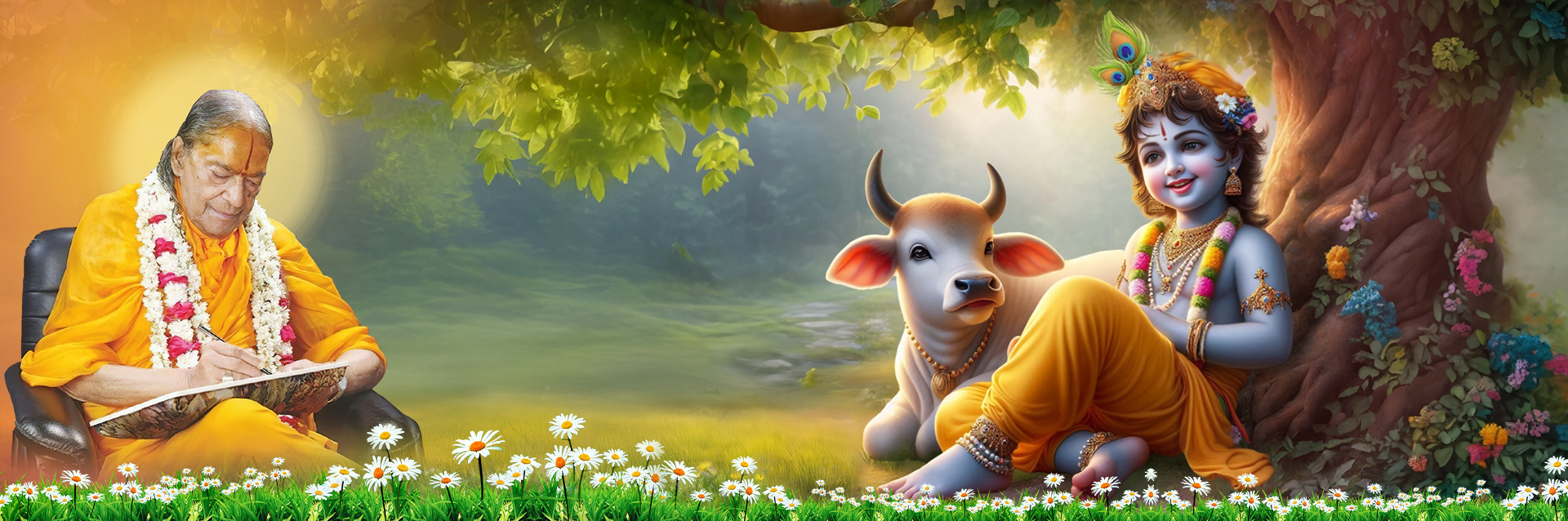

O lovers of the lotus feet of Shri Krishna, the son of Nand, the absolute essence of existence, knowledge and bliss! As is customary, let us begin by chanting the Lord’s name for a while, after which the discourse shall begin.
All glories to Shri Radha Krishna!
Now, all of you please pay attention. Who am I? Who is Mine? These two questions have to be solved. Countless lives have passed, because we are beginningless. And we cannot remain inactive even for a moment; so we have spent every moment solving these two questions. However, up until now, we have not solved these two questions. God Himself has come innumerable times. We have met Saints innumerable times. All of them guided us, and we nodded our heads, “Yes, I understand!” However, we did not understand.
Who am I? To answer this question, we need to take the support of the Vedas and the scriptures. We also did this. The scriptures stated that you are one entity and there are two others. One is Brahm and the other is maya. You are a power of Brahm. Brahm has three powers: one is para shakti; one is jiva shakti; one is maya shakti. Since we are a power of God, we are referred to as a part of Him. What kind of part are we? Marginal. Because … we are not part of Shri Krishna’s para shakti, and we are also not part of Shri Krishna’s maya shakti. However, we are conscious, just as Shri Krishna is, while maya is insentient. Thus, our position is in between God and maya. That is why we are called marginal. The evidence that we are a part of God is, of course, in the Vedas and scriptures; but there is also perceptual evidence. What is that? We desire only God. We consider only God to be ours.
Then what is the conflict? The conflict is that we are not part of the para shakti of Lord Krishna. We are part of Shri Krishna’s specific power known as jiva shakti, and we are under the control of maya. This is why, although we desire God, we strive for the opposite. Listen carefully! Our efforts are in the opposite direction. We say that we have to go west, but we go towards the east due to ignorance. We have knowledge, but we perform actions of ignorance. How very surprising this is! We have knowledge. What knowledge do we have? We desire happiness. Only happiness! Happiness at every moment. Not only humans, all beings who are under the control of maya desire only happiness and make constant efforts for that purpose. Why? Because God and bliss are both one and the same. People only say there is happiness in God just for the sake of explaining it. The Vedas say, “It is not like that.” anando brahmeti Bliss alone is Brahm, God. Raso vai saha He is bliss. The Vedas are not saying raso vai tasmin. It is not that bliss is in Him. He is bliss.
The Vedas say this. anandam brahmano vidvaan The Brahma Upanishad also says anandam brahmano vidvaan. This is also stated in the Shandilya Upanishad at 2.1: anandam brahmano vidvaan All these Vedic mantras state that He is bliss. And the Bhagavat also says this. He is bliss. He is divine nectar. He is happiness. He is nectar. He is happiness. He is bliss. If we accept that bliss is in Him, it implies that God is one entity and bliss is something separate. For instance, we are sitting in this house. This means that we are separate and the house is separate. Look, a rasgulla (an Indian sweet) has two ingredients, doesn’t it? One is the syrup and the other is the cottage cheese. A ball of cottage cheese (gulla) is immersed in sugar syrup (ras), and it becomes a rasgulla. God is not like this. God Himself is bliss. Call Him bliss or call Him God. We are a part of Him. This is why we desire only happiness. We will have to. And as we cannot remain inactive even for a second … we have to strive every moment to attain that bliss. We are compelled to. And we have done so. However, as I have explained over and over again, our efforts were made in the opposite direction. Our effort was wrong.
So, then we took the support of the Vedas and the scriptures. That Brahm, that God, of whom we are a part – what is He like? We need to know Him. Only after knowing and attaining Him will we become the ocean of bliss. Meaning, we will attain bliss. Becoming the ocean of bliss does not mean that we will become God. That is, we will attain bliss.
There are numerous definitions of God. Infinite. Now, I have already explained one: He is bliss. There is another very important definition that you should remember. The one by whom the world is created, the one by whom the world is protected, and the one in whom the world merges is known as Brahm, Bhagavan, Paramatma, Anand.
God desired. Please note this! God desires. Those who say that Brahm, meaning God, does nothing, tell them that this is a Vedic mantra. Taittiriya Upanishad And this mantra is also in the Narayanottara Upanishad. This means that this entire world is manifested from God; it is born from Him. He from whom the world originates, that is Brahm. It is clear! This Vedic mantra is saying that the world originated from bliss. All these Vedic mantras say this. In the Vedant (i.e. Brahma Sutra), a question was posed in the first brahmasutra: athato brahma jigyasa (Brahma Sutra 1.1.1) What is this Brahm? What is God? Who is called God? So, a second sutra was made: janma dyasya yataha (Brahma Sutra 1.1.2) The One from whom the world originates; the One who protects the world; the One in whom the world merges; He is known as Brahm. 1.1.2 And in the Bhagavat too: Right at the very beginning.
So, He is the creator of the world. He is the one who manifests it. And I have repeatedly told you – do not forget – that God did not create anything new. He manifested it. God manifested the world just as it was before. He manifested it exactly as it was before. And what was it like before? It was according to the karmas of each individual soul. And karm is beginningless; birth is also beginningless. This has been described in detail in the Vedant, in sutras 2.1.34 and 2.1.35.
So, there are infinite definitions of God. The main one is that He is bliss and He performs the work of creation and so on. No Saint performs the work of creation. Apart from these, He has infinite qualities and infinite powers, all of which are eternal. However, out of the two forms of God, in one form, that is Brahm, not all of His powers are manifested. He is known as Avyaktashaktik Brahm. In the personal form of God, Shri Krishna, all the powers are manifested. This is the difference. Brahm is also endowed with all the powers. I have repeatedly explained this to you, with examples. The powers are not manifested, just like seeds of wheat stored in a sack. The branches, leaves and fruit are all there, but they are not manifested. It is in Shri Krishna’s form that they are manifested.
This is why we say that we are a part of Shri Krishna. Therefore, we desire only Shri Krishna. In other words, we desire only bliss. That is why Sage Valmiki issued a challenge. Such a great challenge! “In this world, there isn’t a single being who is not a devotee of my Lord Ram, because everyone is a devotee of bliss.” And bliss is Shri Ram, Shri Krishna alone. So, everyone is a devotee of Ram and Krishna.
Now, although we may not have been able to attain Him for whatever reason, we desire only Him, and we constantly strive only to attain Him. Whatever means we have for attaining Him are all material. Therefore, the Vedas said, “You have to do something.” Then His grace will be bestowed. Then He will give His power to our senses, mind and intellect. Then you will be able to attain Him with those senses, mind and intellect. Then you will be liberated from maya and attain bliss forever.
So, we contemplated upon what needs to be done, and there are only three things that can be done as we are part of sat, chit and anand – karm, gyan, and prem. So, we reflected upon karm, and learned through the Vedas and Shastras that if karm is duly performed as prescribed – pay attention to each and every word – as prescribed! If there is a mistake in one accent of one letter of one word of one mantra, then the person performing the ritual will be ruined. The rules are so strict. The celestial gods are just like worldly people. They are our brothers. For example, a servant serves tea and meals to his employer. Now, if he adds salt to the food instead of sugar, or while offering tea, he spills a little on his employer’s hand, what would the employer say? “Get out!” – “Sir, I have been serving you for 20 years. Did I deliberately spill the tea on you?” “How dare you argue!” No one forgives in the world. The celestial gods are the same. They have their own rules and regulations: what each celestial god should wear or eat. Everything is different for each one. One has to act accordingly. A slight mistake will result in punishment.
And if someone does perform karm as prescribed, then he will attain the celestial realm. Maya, ignorance and unhappiness also prevail there. There is desire, anger, greed and infatuation there too, and the happiness there is limited. There is limited happiness for a limited period only.
Then tell me, why has varnashram dharm been highly praised by God? And He has said: “If anyone neglects varnashram dharm, then he is My enemy. I will punish him. It was I who established varnashram dharm.” “Arjun! The four divisions in society were established by Me. These should not be violated. And even those who practise devotion to Me will be punished if they violate these rules.”
So tell me, if we practise devotion to You, You have specified one condition. What? Only! “The mind should be attached only to Me.” So if we attach our mind to the celestial gods, we will not be exclusive.
So, God replied, “Yes, what you are saying is correct.” Look, it is like this. “My law is that if a person renounces varnashram dharm and surrenders to Me alone, I will be very pleased. I will not punish him. But if he renounces varnashram dharm and becomes whimsical and unrestrained, I will punish him.”
Alright. Narad Ji says, “If someone renounces ritualistic duties and surrenders to God, and, by chance, has a downfall midway, then God supports him.” Therefore, do not be afraid. When a child first learns to walk, he falls down again and again. No one starts running immediately. First he will start crawling on his knees. Then gradually he learns to stand. Then he walks unsteadily. After that, he starts to run. So, in the same way, even if you fall, you should not be disturbed. 1.5.17
This varnashram dharm has been described in extensive detail in the Vedas, the Smritis and the Mahabharat. Those who follow varnashram dharm are the greatest fools. Why? What does one gain from it? Fame. You will gain respect. Honour. You will get worldly things in abundance. You will have opulence and wealth in your next birth.
Is it all for this? If you get the material world, that is even more harmful. God says “I take away the worldly possessions of those on whom I bestow grace.” I take away the worldly possessions of the one on whom I bestow grace. When I bestow grace on someone, I take away his opulences. This is why Kunti asked for a boon: Bhagavatam 1.8.25 1.8.26 “O Lord!” She was standing in front of Shri Krishna and asking for a boon. “Take away whatever worldly possessions I have.” Why? If a person possesses even a single material thing in abundance like just beauty, or only wealth, or any one skill like the ability to sing well: if he has even one quality in abundance, people will surround him. “Oh! That singer has come! Oh, he’s here! Let’s go and see him.” Oh, what will you see? He has the same eyes, ears and nose as you have. “But what a great singer he is!” Alright, he may be a singer. Thousands of people go. And when the singer sees the crowd, he thinks, “Yes, I am someone special! My position comes just after God.”
Everyone experiences such feelings. When one is young, even if he or she does not have wealth or any qualities, and is illiterate, still that boy or that girl walks with arrogance.
A scholar wrote: Verse At the age of sixteen, even a donkey thinks she is a celestial damsel. A washerman’s donkey!
Once, a girl happened to meet a celestial god who was on his way somewhere. The celestial god thought of playing a joke. So, he said, “O daughter, come here.” She went to him. He said, “I am a celestial god. You may ask me for a boon.” – “Ask you for a boon?” The girl was around sixteen or eighteen years old. She said, “I don’t want any boon. You can give me whatever you want.” So, the god asked her, “Shall I make you beautiful?”
The girl promptly slapped him saying, “Do you think I am ugly? There are always three or four boys following me around!”
Now what if a person has many qualities: good looks, wealth, and many other qualities, how egoistic will he be?
Scriptural Verse (Ramayan)
A monkey is extremely naughty by nature. Now imagine that this monkey is possessed by a spirit. Then what will its state be? And suppose that monkey suffers from hysteria. Now what would its condition be? Again assume that it is stung by a scorpion. Now what would its condition be? And then make him drink two bottles of wine. Now what will the state of this monkey be?
This is exactly our condition. If we have three or four qualities, then imagine the state of our pride.
Tell me, don’t you go to attend the lectures? “No, I don’t have the time.” He replies so arrogantly, “I don’t have time.” The billionaire is on the phone throughout the day in his office. He has no time!
I will take a little of your time to narrate an actual episode from my life. Raigarh is a place near Bilaspur. I went there in the very beginning to give lectures. There was a very wealthy businessman there. His name was Karodimal. Almost half of the town belonged to him. He was a billionaire. So, I sent him a message saying, “I have come to your town. I am your guest. So, my request is that you should come and attend my lectures.” I gave lectures for ten to twelve days, but he did not come even once. After all, he was a billionaire! If the prime minister were to visit, he would go and follow him around so that he could get a business license and earn a few billion more. What would he get by coming to a Jagadguru?
Anyway, on the last day, when I was about to leave, he sent ten or twelve rich businessmen along with a request that I should visit his residence, Seva Kunj. “Please come just for two minutes and sanctify it. All the Jagadgurus pay a visit there.”
So, I thought of a joke. I wrote a poem and sent it over to him. Listen to what I wrote:
“You are intoxicated with the material world. You are intoxicated with the material world. You have the world. And I am intoxicated with the Master of the world. We are both intoxicated. You are intoxicated with the material world, and I am intoxicated with the Master of the world. My beloved is the cup-bearer of pleasure, while you are a lover of an empty goblet. You and I will not get along. That’s all.”
After that I left. Shri Ravi Shankar was the chief minister at that time. I went to stay at his place and began delivering discourses in Nagpur. Karodimal arrived at the chief minister’s place saying, “Jagadguru Ji became annoyed and left. Please request him on my behalf to visit my place.” Ravi Shankar said, “I can’t say that to him. I don’t have the courage to do that. You go and tell him. You must have made some mistake.”
So, in the world, the intoxication of worldly possessions is so great that the person says he does not have time. When he gets punished after death, then he realises, “Oh, I made a great mistake.”
So, our happiness is not in this world. This truth must be firmly fixed in the intellect. As I explained yesterday, no one in the world does anything for the sake of another’s happiness. Everyone is striving only for their own happiness. That divine bliss is not in this world, right up to the abode of Brahma. So, our aim will not be fulfilled through ritualistic actions.
Two days ago, I placed a question before you that Shaunak and the other paramhansas had asked Sut Ji, “Tell us of an easy path by which we can attain our bliss.” ‘Our’ means that of the soul. “However, it should be suitable for the people of Kali Yug (the current dark age). It should not be a difficult path.”
So, Sut Ji gave the answer:
Scriptural Verse (Bhagavatam 1.2.6)
There are two kinds of dharm. First understand the philosophy so that you are free from confusion forever. Dharm is of two types. Why? Because there are only two personalities apart from us, aren’t there? Listen very carefully! One is God; the other is maya. So, we will either accept God or we will accept maya. So, there are only two types of dharm. Dharm means that which is worthy of being adopted. And we are these two: the soul and the body.
So, the dharm of the body is the world. The dharm of the soul is God. This means that the soul should adopt God, and the body should adopt the world. Our aim will then be achieved. So, the dharm of the body is known as apara dharm or mayic dharm, or trigunatmak dharm or agantuk dharm. And the dharm of the soul is known as adhyatmik dharm, para dharm or svabhavik dharm. This does not change. However, the dharm of the body keeps changing.
How? Look, until you are 25, the Guru’s orders are to follow celibacy. “Don’t even look at the face of a woman until you are 25.”
- “Alright.”After he turns 25, Guru Ji returns and says, “Get married to a girl.”
- “For all these years, you taught me to not even look at a woman’s face, and now you are telling me to get married?”“Hey, don’t argue, just do as I say.”Now the dharm has changed.
- “Well, this must be right.”Now he gets married, has a few children and becomes attached to all of them. He even has grandchildren in due course. Now he is 50 years old. Again the Guru comes, “Hey, leave everyone. You and your wife go to the forest.”
- “What? Leave everyone? These children are ours; we raised them. We have become attached to them.”“Yes, it is to remove the attachment that I am telling you this.”Now the husband and wife live together in the forest for 25 years. The Guru now says, “Hey, come here. Who is she to you?”
- “My wife.”“You fool! She is not your wife. You have had countless wives in your countless births. You have even had dogs and donkeys as your wife! You have taken birth countless times in the 8.4 million species. Yet you call her your wife! You think she is yours! At the age of 25, you circled the fire seven times, so you say ‘This is my wife!’ She is not yours. Turn around. Both of you should separate and practise devotion to God.”
Just imagine! The Guru takes him back to the stage of celibacy. The dharm is changing, isn’t it?
The brahmin, kshatriya, vaishya and the shudra – all have a different dharm. In the Mahabharat, Sage Veda Vyas explained, “The rules of dharm have a purpose.”
Scriptural Verse (Mahabharat)
Varnashram dharm has been established for the organised functioning of the world. If everyone joins the army, how will the government function? Some should join the army; some should join the police; some should become clerks. Some should join the PWD (Public Works Department); some should teach in schools. Human beings have various needs, so everyone has separate departments. That is the reason why I have said that brahmins should study the Vedas and scriptures and teach others. The kshatriyas should fight wars and protect the country. Different duties for everyone – that is the purpose. The welfare of the soul will not be achieved through this dharm.
So, what is the true dharm? Sut Ji gave the answer. The verse I recited earlier is 1.2.6.
Again Sut Ji said:
Scriptural Verse Bhagavatam 1.2.8
If the follower of dharm does not attain love for Shri Krishna, then that dharm is adharm. It is useless. He might presume that he has meticulously practised dharm.
Scriptural Verse Bhagavatam 1.2.13
What is the outcome of dharm? The result of dharm is love for Lord Krishna. If that love is not there, that dharm is wrong.
Scriptural Verse Bhagavatam 1.2.29
Scriptural Verse Bhagavatam 11.19.27
Only that dharm which fosters love for God is dharm in the true sense. The rest is physical dharm, the result of which is mayic.
Scriptural Verse (Bhagavatam 7.9.10)
Listen to this! Bhagavatam 7.9.10
If a learned Brahmin is endowed with all the twelve qualities and is also a follower of dharm, but is bereft of devotion to Lord Krishna, then he is condemnable. On the other hand, an untouchable who is a devotee of Shri Krishna is praiseworthy.
Scriptural Verse Padma Purana
God is saying, “A sin performed for My sake will be considered dharm; while any dharm performed excluding Me will be considered a sin.”
Scriptural Verse Skanda Purana
The devotee of Shri Krishna is accepted to have performed all the prescribed religious duties. And the one who has not practised devotion to Shri Krishna will commit nothing but sin. And virtuous actions? Will he not perform virtuous actions? Even virtuous actions are sin! Why? Because they also cause bondage. One goes to the celestial realm and is again thrown back to the material world.
So …
Scriptural Verse (Kaushitaki Upanishad 1.4)
This mantra is in the Kaushitaki Upanishad at 1.4. It is only when both virtuous actions and sins are destroyed that one can attain liberation. Virtuous actions also cause bondage because one attains the celestial realm. So, virtuous actions are also sin because they result in suffering and bondage.
So, in this way, the Vedas, the Upanishads, the Brahma Sutra, the Bhagavat and the Puranas all say that if ritualistic actions are duly performed as prescribed – listen to the conclusion – then you will attain the temporary celestial abodes; and if they are not performed as prescribed, you will be punished.
Now, in this Kali Yug, the strict performance of prescribed karm is impossible. And what does the Gita have to say about this?
The clock says, “Explain it tomorrow!” All glories to Shri Radha Krishna!

